The Feature Request Trap: When to Build a Capability
Part of the The Operator Problem series
A teammate asked for one highlight on a map. I built something else - and skipped the nine-year detour Apple took with Do Not Disturb. Here's how to spot the capability hiding in a feature request.
5 min readStartup Building & Entrepreneurship💌 Tiny Improvements

The Big Idea
A feature answers the request in front of you. A capability answers the requests you haven't gotten yet. Knowing which to build is a skill - and most of us learn it the hard way.
The feature request that was really a capability
At Craftwork, we visit some sales leads in person before we quote their project.
I'd just built a map view of our leads, and the team was using it. Then a request came in: could the map highlight leads with on-site visits this week?
Clear, specific, and worth building. But I could already hear the next request: this week and next? Then: on-sites, plus good candidates for next week?
The request wasn't wrong. People describe the pain in front of them. Designing the system underneath is my team's role.
When your endpoint name reads like a sentence
Building exactly what was asked would have looked like this:
1const leads = api2.v13.leads4.highlight5.scheduledOnSiteVisitsThisWeek();
You probably winced. When a name reads like a sentence, the parameters are baked in. Every variation is a new endpoint, a new ticket, a new deploy.
So... we built something else. Our list views already had filters: give them rules, get matching leads. We added a highlight endpoint that uses the same set of rules, and returns highlights instead:
1const highlights = api.v1.leads.highlight({2status: 'scheduled',3visitType: 'on-site',4when: 'this-week',5});
The team pushed back - generic sounds slower. It wasn't. We'd already invested in filtering when we built the list endpoint, so reusing it was faster and cheaper than building a new, specific endpoint.
Capabilities compound. Each one makes the next one cheaper.
Ship the feature request, then show what else it can do
Once highlighting was ready to ship, I wanted to show the team what it could do.
I used a little reverse devrel, and shared a short video showing how to highlight this week's on-site visits. Then, by the way - the same menu highlights every exterior project. Or everything assigned to a specific account manager. Or everything priced over $10,000.
It looked just like the filters the team already used, so there was nothing to learn.
Lead with the request, then show the permutations.
Do Not Disturb: nine years of special cases
If you're a long-time iPhone user, you got to live through this with Do Not Disturb for iOS:
- 2012: iOS 6 introduces Do Not Disturb.
- 2017: iOS 11 adds Do Not Disturb While Driving.
- 2018: iOS 12 adds Bedtime mode.
- 2021: iOS 15 replaces them all with Focus: build your own modes, with your own rules. Do Not Disturb, Driving, and Sleep become presets.

Each special case was reasonable. Together, they were a capability waiting to happen - and Apple had the time and money to go back and build it.
Most features don't get a Focus. They get the Homer.
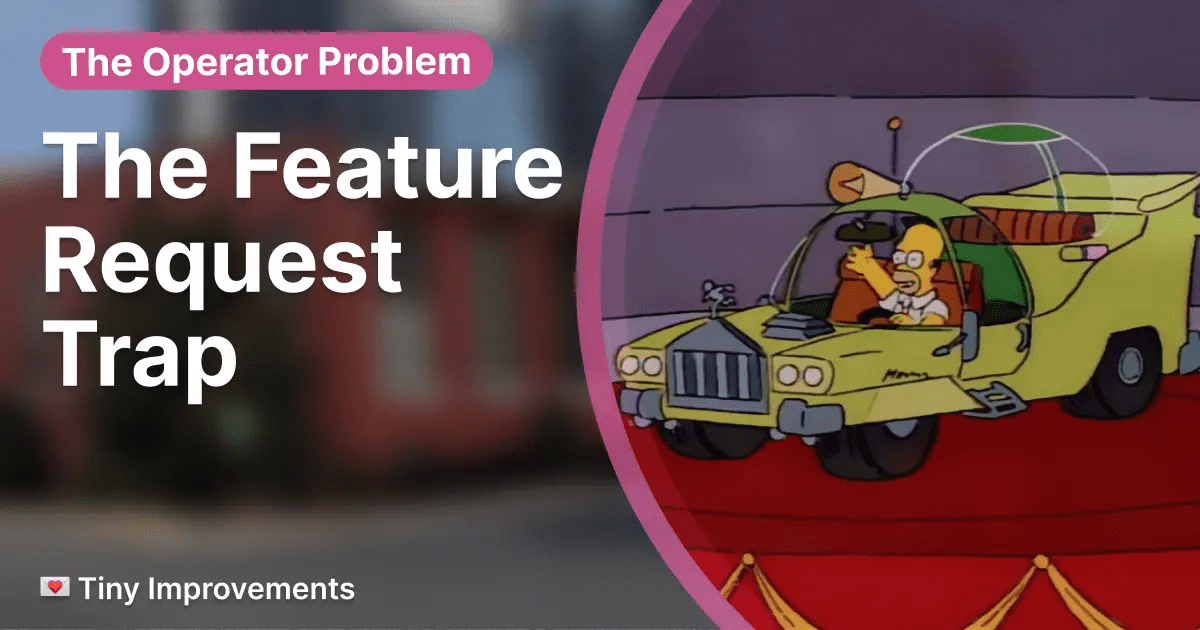
Most teams don't get that rebuild. In a classic episode of The Simpsons, Homer's long-lost brother Herb lets him design a car for the average American. Homer asks for everything: a bubble dome for the kids, tail fins, three horns that all play "La Cucaracha." Every idea makes sense to the guy asking.
The Homer bankrupts Herb's company.

That's the feature request trap. Every bolt-on is reasonable, nobody has time to step back, and the whole ends up worse than the sum of its parts.
How to spot a capability hiding in a feature request
How did I know the map request would creep? Scar tissue.
I've built the specific version before, then found ten more versions waiting behind it, each requiring engineering time to implement. Do that enough, and it becomes an immune response.
No scars yet? Look for two tells:
- High specificity.
scheduledOnSiteVisitsThisWeek()bakes in three decisions: a status, a visit type, and a time range. A change in any of these would become a future request. - You can't finish the list. Sales statuses: new, investigating, waiting for feedback, verbal offer, sold... Are you sure that's all? If you can't write the complete list, don't hardcode it. Build the thing that holds the list.
You don't have to build the whole generic system on day one. You just have to see what it would look like - and not paint yourself into a corner.
When the simple version is the right call
This practice is in tension with something I believe just as strongly: build just enough. The tiebreaker isn't will this change? It's what will the change cost?
- When growth is additive, start small. My personal health app started with weight and BMI. Resting heart rate and VO2 max snapped in later. Nothing got rebuilt.
- When you're the only user, keep it simple. This newsletter goes out through Resend Broadcasts. Instead of building an editor, a CI action drafts the broadcast from markdown, and I send it from Resend. Sometimes the best capability is one someone else built.
- When it feels stapled together, stop stapling. If maintaining a feature means working around how it was bolted together, the simple version has run its course. That's your cue to build the capability.
What the operator problem asks of you
When a capability is good, people use it constantly without noticing. Nobody files a ticket. Nobody pings an engineer. That's the point - and why it's easy to forget to celebrate.
We're still building this muscle at Craftwork. You build it through repetition, and by looking back at what you shipped and asking what it should have been.
The operator problem starts the moment people depend on something you built. This series covered four shifts:
- Rebuild without stopping the business. When your prototype becomes the product, you can't just start over.
- After the MVP, the work changes. Builder and operator are different jobs.
- Every MVP has an event horizon. Know which mode each system needs.
- Features become capabilities. Stop building the same button twice.
This week, go find one function whose name reads like a sentence.
Operator problems are good problems. They mean something you built mattered. And when the system handles the variations, your engineers finally get their own Focus mode.